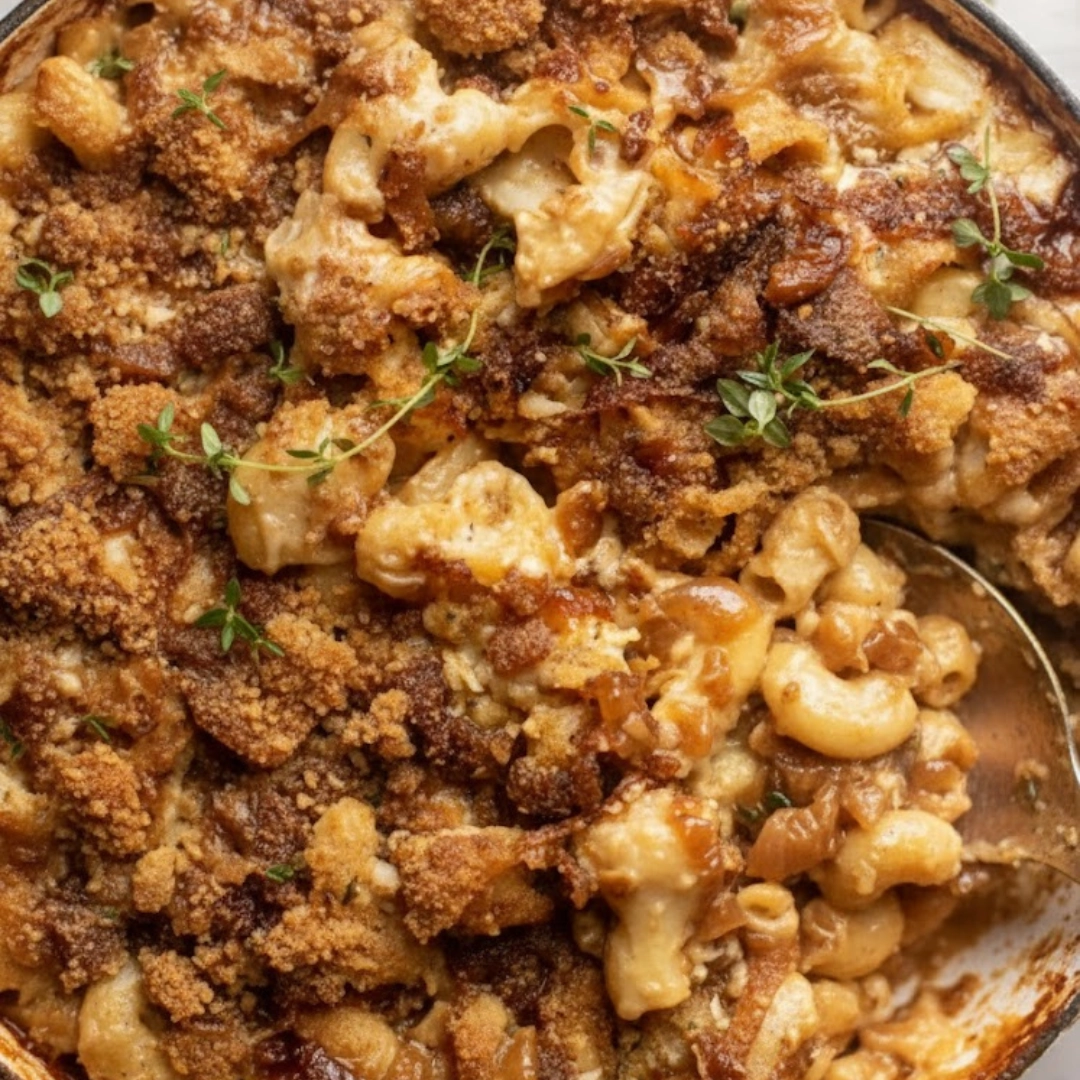
This French Onion Mac and Cheese brings together deeply caramelized onions, a rich Gruyère–Cheddar cheese sauce, and perfectly baked pasta for a casserole that’s both creamy and savory. The recipe focuses on two essential techniques: slow-cooking onions until sweet and golden, and building a smooth, velvety sauce with a classic roux. Finished with a crisp, golden panko topping, this dish delivers the comforting creaminess of mac and cheese with the bold, umami depth of French onion soup. It’s a reliable, flavorful option for weeknight dinners, holidays, or any time a crowd-pleasing baked pasta is needed.
Table of Contents
The Essential Elements of Our Ultimate French Onion Mac and Cheese
A successful recipe hinges on two main elements: the slow-cooked onions and the balanced, rich cheese sauce.
Why Caramelization is Non-Negotiable (The Maillard Reaction)
The signature flavor of French Onion Soup comes from the lengthy process of cooking onions down until they transform from sharp, pungent rings into deeply sweet, nutty, and savory masses. This process is known as caramelization and involves the Maillard Reaction—a complex chemical reaction between amino acids and reducing sugars.1
- Time is Flavor: Do not rush this step. The onions must cook slowly over medium-low heat for 45 to 60 minutes.
- Color Development: The deep mahogany color is not burning; it’s the development of thousands of new flavor compounds. This rich flavor is the backbone of the French Onion Mac and Cheese.
Our Tested Cheese Blend for Maximum Flavor and Creaminess
Based on my experience adjusting flavors for different palates, the best cheese sauce requires a balance between great meltability and bold, authentic flavor.
| Cheese Type | Role in the Dish |
| Gruyère | Provides the essential, authentic French Onion Soup flavor. It melts beautifully and has a nutty, earthy depth. |
| Sharp White Cheddar | Offers the classic, tangy mac and cheese backbone and helps create a smooth, thick sauce. |
| Parmesan | Used sparingly, mainly for adding a final umami, salty punch to the topping. |
Ingredient List: What You’ll Need
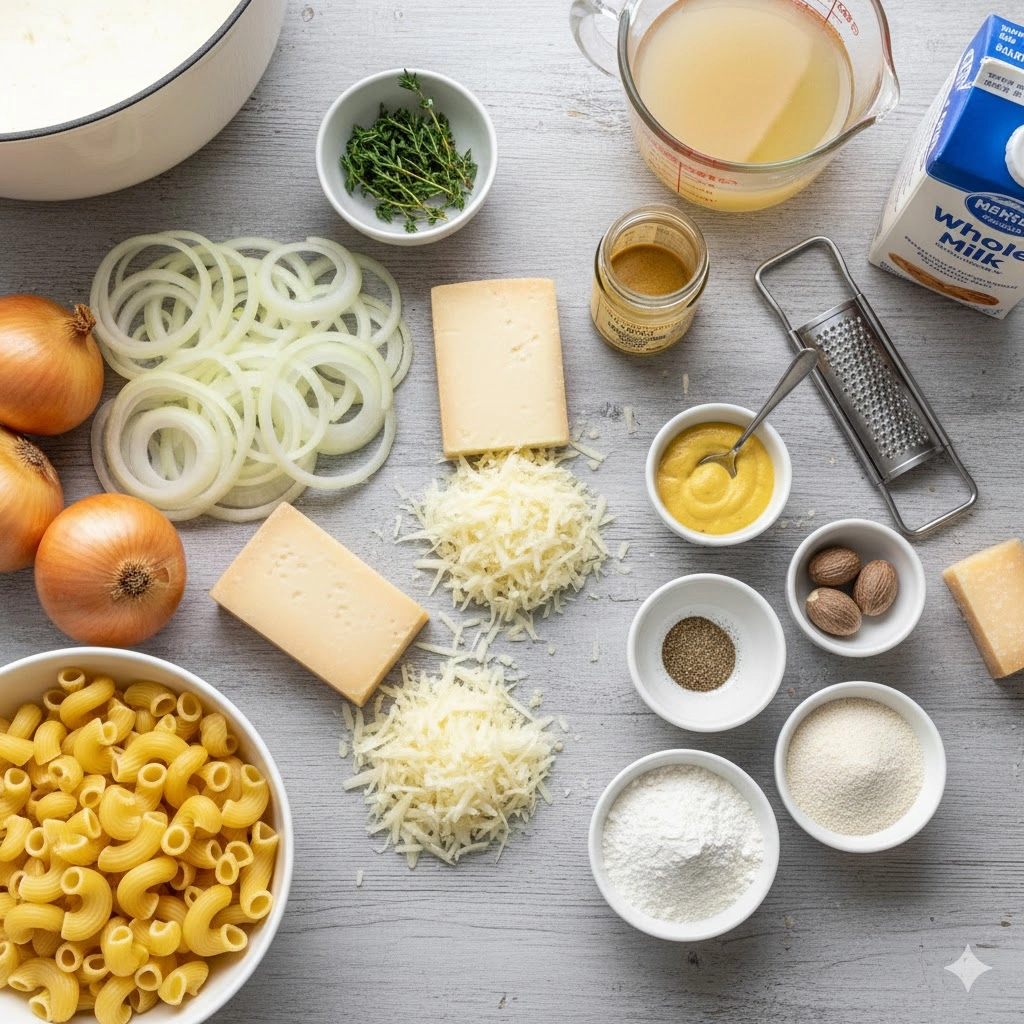
For the Caramelized Onions
- 4 medium Yellow Onions (or 3 large), thinly sliced
- 2 tablespoons unsalted butter
- 1 teaspoon fresh thyme leaves
- 1/2 teaspoon kosher salt
- 1/4 cup vegetable or beef broth
For the Mac and Cheese
- 1 pound dry pasta (e.g., cavatappi, elbow, or shells)
- 1/2 cup (1 stick) unsalted butter
- 1/2 cup all-purpose flour
- 4 cups whole milk, warmed
- 1 teaspoon Dijon mustard
- 1/2 teaspoon black pepper
- 1/4 teaspoon nutmeg
- 8 oz. Gruyère cheese, freshly grated
- 8 oz. Sharp White Cheddar, freshly grated
- Salt to taste
For the Topping
- 2 tablespoons unsalted butter, melted
- 1 cup panko breadcrumbs
- 1/4 cup grated Parmesan cheese
Master the Creamy Sauce: Step-by-Step Instructions
Achieving the perfect consistency for the cheese sauce is simple once you understand the basic technique.
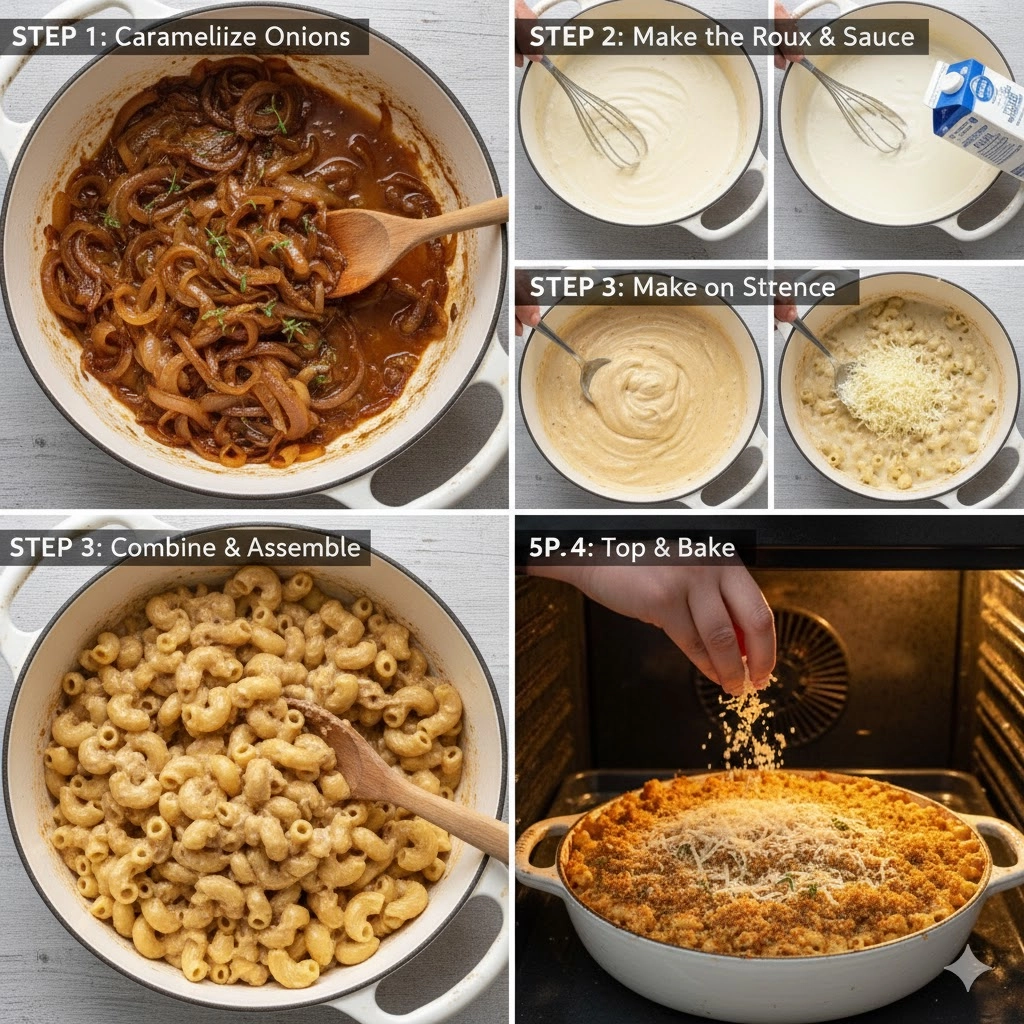
Step 1: Perfectly Caramelizing the Onions
- Sauté: Melt the butter in a large Dutch oven or heavy-bottomed pot over medium-low heat. Add the sliced onions, salt, and thyme. Cook, stirring occasionally, for 45–60 minutes. They should be dark golden brown and greatly reduced in volume. This step requires patience.
- Deglaze: Once caramelized, pour in the broth and stir, scraping up any browned bits from the bottom of the pan. Set the onions aside.
Step 2: Building the Velvety Cheese Sauce (The Creamy Roux)
- Cook Pasta: Bring a large pot of salted water to a boil. Cook the pasta until al dente (1-2 minutes shy of package directions). Drain and set aside.
- Make the Roux: In the same pot used for the onions (or a clean one), melt the butter over medium heat. Whisk in the flour and cook, stirring constantly, for 1–2 minutes. This raw flour smell disappears as the starch cooks.
- Add Milk: Gradually whisk in the warm milk until the sauce is smooth. Bring the mixture to a simmer, stirring until thickened, about 5–7 minutes. The sauce should coat the back of a spoon.
- Add Flavor and Cheese: Remove the pot from the heat. Whisk in the Dijon, pepper, and nutmeg. Add the grated Gruyère and Cheddar in small batches, stirring until each batch is completely melted and the sauce is smooth before adding the next. Taste and add salt as needed.
Step 3: Assembly and Baking for that Signature Gratin Finish
- Combine: Gently fold the reserved caramelized onions (saving about 1/4 cup for garnish) and the cooked pasta into the cheese sauce until everything is evenly coated.
- Bake: Transfer the mixture to a buttered 9×13-inch baking dish.
- Topping: In a small bowl, mix the melted butter, panko, and Parmesan. Sprinkle this mixture evenly over the mac and cheese.
- Final Cook: Bake at $375^{\circ}\text{F}$ for 20 minutes, or until bubbling hot and the topping is golden brown and crisp. Let it cool for 10 minutes before serving.
Culinary Tips and Tested Tricks for a Perfect Result
As someone who has cooked this dish for years, I’ve developed several methods to guarantee success and offer great flexibility.
Troubleshooting: How to Avoid a Grainy Cheese Sauce
The most common issue with homemade cheese sauce is a grainy or split texture, which is usually caused by overheating the cheese or adding it too quickly.2
- Never Boil the Cheese Sauce: Once the flour and milk base (béchamel) is done, remove the pot completely from the heat before adding the cheese. High heat can cause the milk proteins to seize and separate from the butterfat.
- Grate Your Own Cheese: Pre-shredded cheese contains anti-caking agents (like potato starch) which prevent it from melting smoothly, almost guaranteeing a grainy texture.3 Always grate high-quality blocks of cheese yourself.
Flavor Variations and Easy Ingredient Swaps
While the traditional blend is superb, you can tailor this mac and cheese to your pantry and preferences.
- Broth Swap: If you want a more intensely savory profile, use high-quality beef stock for deglazing the onions instead of vegetable broth.
- Cheese Alternatives: For a slightly sharper flavor, substitute the Sharp White Cheddar with aged Gouda. For those who love a smoky flavor, a small amount of smoked Gouda works well. For more ideas on pasta dishes that welcome creative substitutions, consider exploring different bucatini pasta recipes. (Internal Link 1)
- Pasta Shape: This recipe works beautifully with almost any sturdy shape. I recommend avoiding delicate varieties like in a marry me shrimp pasta (Internal Link 2) to ensure the pasta holds up to the thick sauce and baking time. Instead, stick to shapes like shells, rotini, or even a hearty baked dish like a one pot ground beef pasta recipe. (Internal Link 3)
Serving, Storage, and Prep Strategies
Mastering the logistics of prep, serving, and storage ensures this decadent meal can fit into any schedule.
What to Serve Alongside Your Decadent Pasta Dish
Because dish is inherently rich and savory, the best side dishes offer a counterbalancing lightness, acid, or bitterness.
- Crisp Salad: A simple vinaigrette-dressed mixed green salad cuts through the richness beautifully.
- Blanched Greens: Simple steamed or blanched asparagus, green beans, or broccoli lightly seasoned with lemon juice.
- Poultry: For a complete meal, this mac and cheese pairs wonderfully as a side to a simple baked chicken breast or even a hearty main like turkey with gravy sauce. (Internal Link 4)
- Vegetarian Options: This dish is filling enough to stand alone, but if you want to pair it with another side, a light gnocchi with spinach and feta recipe (Internal Link 5) can offer complementary flavors without overwhelming the meal.
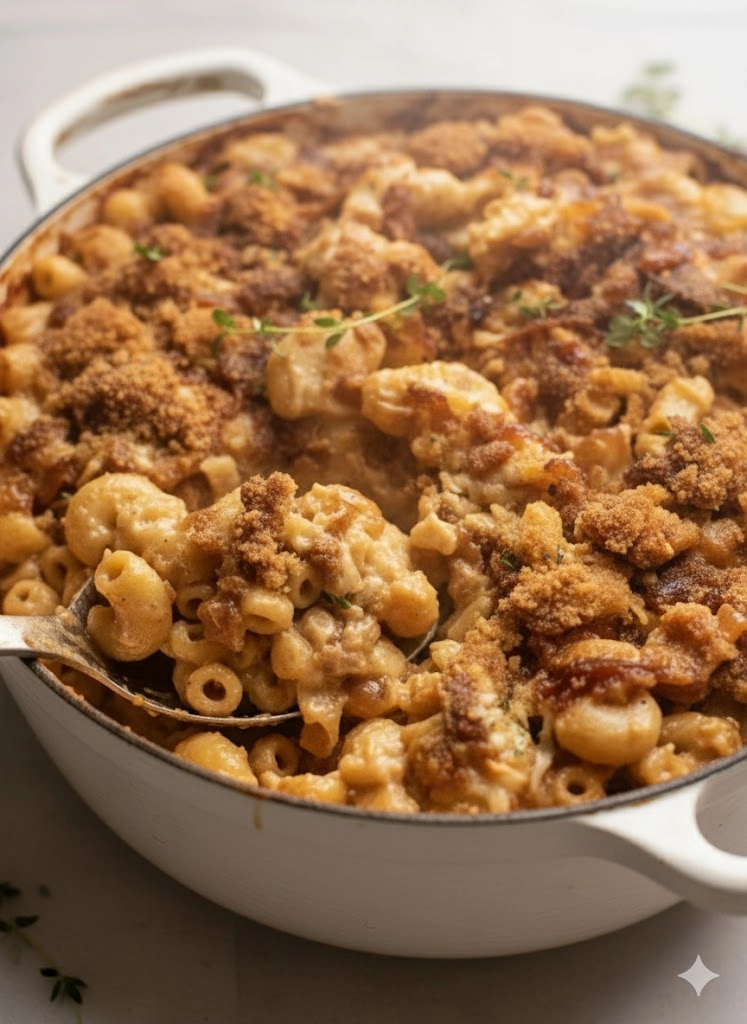
Can You Make French Onion Mac and Cheese Ahead?
You can successfully prep this dish in advance, which is perfect for holiday meals or entertaining.
- Prep Ahead: Follow all steps up to and including transferring the mixture to the baking dish (Step 3). Do not add the breadcrumb topping yet.
- Storage: Cover the baking dish tightly with plastic wrap and refrigerate for up to 24 hours.
- Baking from Cold: When ready to bake, remove the dish from the fridge 30 minutes prior to baking. Preheat the oven, add the breadcrumb topping, and bake as directed, adding an extra 5–10 minutes to the total baking time to ensure it is heated through to the center.
Storing and Reheating Leftovers for the Best Experience
Like most baked pasta, this dish sets up when cooled.
- Storage: Store leftovers tightly covered in the refrigerator for up to 4 days.
- Reheating: The best method is in the oven. Preheat to $300^{\circ}\text{F}$. Add a splash of milk or broth to the portion to prevent dryness, cover the dish with foil, and bake until hot (about 15-20 minutes). If you must use a microwave, reheat slowly at 50% power to prevent the sauce from separating.
Don’t miss to Follow us in Pinterest.
Frequently Asked Questions (FAQs)
Why does my mac and cheese sauce feel gritty or oily?
This often happens when the cheese is added to a sauce that is too hot, causing the fat and protein to separate. Always remove the béchamel (milk/roux base) from the heat before stirring in the grated cheese slowly. Also, ensure you are grating cheese from a block, as pre-shredded varieties contain starches that make melting difficult.
Can I substitute the Gruyère cheese?
Yes, but you will lose some of the signature French Onion flavor. The closest substitutes are Comté or high-quality Swiss cheese, though they may be slightly less complex. If you cannot find Gruyère, use a little extra sharp Cheddar combined with a touch of aged Provolone for depth.
What is the best pasta shape for this recipe?
Any short, sturdy pasta shape with ridges or tubes works best, as they trap the thick, rich sauce and onions beautifully. Cavatappi, elbow macaroni, shells, or even fusilli are excellent choices. Avoid long, thin strands.
Can I use vegetable broth instead of beef broth?
Absolutely. While traditional French onion soup often uses beef broth for depth, vegetable broth works perfectly well, especially if you are serving this as a vegetarian side. The key is ensuring the broth is high quality and concentrates the savory flavors as you deglaze the onions.
The Ultimate, Tested French Onion Mac and Cheese Recipe
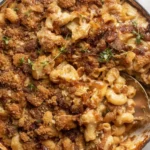
Our ultimate, tested homemade French Onion Mac and Cheese recipe expertly combines creamy Gruyère-Cheddar sauce with slow-cooked, deeply savory caramelized onions and a crunchy panko topping.
- Prep Time: 25 mins
- Cook Time: 70 mins
- Total Time: 1 hour 35 mins
- Yield: 8 servings 1x
- Category: Main Dish, Casserole
- Method: Baking
- Cuisine: American, French
Ingredients
4 medium Yellow Onions, thinly sliced
2 tbsp unsalted butter (for onions)
1 tsp fresh thyme leaves
1/2 tsp kosher salt (for onions)
1/4 cup vegetable or beef broth
1 pound dry pasta (cavatappi or shells)
1/2 cup (1 stick) unsalted butter (for roux)
1/2 cup all-purpose flour
4 cups whole milk, warmed
1 tsp Dijon mustard
1/2 tsp black pepper, 1/4 tsp nutmeg
8 oz. Gruyère cheese, freshly grated
8 oz. Sharp White Cheddar, freshly grated
Salt to taste
2 tbsp unsalted butter, melted (for topping)
1 cup panko breadcrumbs
1/4 cup grated Parmesan cheese
Instructions
1. Melt 2 tbsp butter in a large pot over medium-low heat. Add onions, 1/2 tsp salt, and thyme. Cook until dark golden brown, about 45–60 minutes.
2. Pour in the 1/4 cup broth and scrape up any browned bits. Remove onions and set aside.
3. Cook pasta until al dente. Drain and set aside.
4. In the same pot, melt the remaining 1/2 cup butter. Whisk in 1/2 cup flour and cook for 1–2 minutes.
5. Gradually whisk in the 4 cups of warm milk. Bring to a simmer, stirring until thickened. Remove from heat.
6. Whisk in Dijon, pepper, and nutmeg. Add Gruyère and Cheddar gradually, stirring until smooth.
7. Gently fold in the cooked pasta and most of the caramelized onions.
8. Transfer to a buttered 9×13-inch baking dish. Top with panko, Parmesan, and melted butter.
9. Bake at 375°F for 20 minutes, or until bubbling and golden. Let cool for 10 minutes before serving.
Notes
For the smoothest sauce, always grate your own cheese from the block.
This dish can be prepped up to 24 hours ahead, but add the topping just before baking.
Reheat leftovers in the oven with a splash of milk or broth to prevent dryness.
Nutrition
- Serving Size: 1 bowl
- Calories: 650
- Sugar: 8g
- Sodium: 650mg
- Fat: 33g
- Saturated Fat: 20g
- Unsaturated Fat: 8g
- Trans Fat: 0g
- Carbohydrates: 55g
- Fiber: 3g
- Protein: 35g
- Cholesterol: 105mg